
Here’s the number that matters most in this whole conversation, and it isn’t a percentage on a chart. It’s two. Two doors lead to the same molecule in 2026, and which one you walk through changes your risk far more than the compound itself does. I’ll get to the trial data in a minute, because some of it is genuinely strong. But if you remember one thing from this piece, remember that the door matters more than the drug.
Disclosure up front: this explains a category, not a single product. Every regulatory and clinical claim below links to a primary source you can check yourself. The compounded and prescription medications discussed are not FDA-approved, and the FDA does not verify compounded drugs for safety, effectiveness, or quality before they reach a patient. Last reviewed June 2026.
Peptides are short chains of amino acids, small signaling molecules your body already makes by the thousands. The lab-made versions people search for online copy those signals: grow this, heal that, release this hormone, feel full. Some of those copies have serious clinical trial evidence behind them. Others have almost none. I want to separate the two groups cleanly, because the marketing rarely does.
Who’s actually shopping for this, and why the segmentation matters
Three groups make up most of the search traffic, as far as I can tell from how this category behaves. People chasing meaningful weight loss who’ve tried the standard playbook and want semaglutide or tirzepatide. People recovering from an injury who read about BPC-157 or TB-500 on a forum. And a longevity-and-optimization crowd chasing skin, sleep, and muscle. A fair number of people in that last group already have a vial sitting in a drawer, purchased before they thought too hard about it.
I’m not going to tell any of these people to stop caring about their bodies. I’m going to try to give each group an honest number to weigh their decision against.
The evidence, ranked, not blended
The worst habit in this space, on the hype side and the fear side both, is treating every peptide as equally proven. They are not close to equal. Here’s the actual hierarchy.
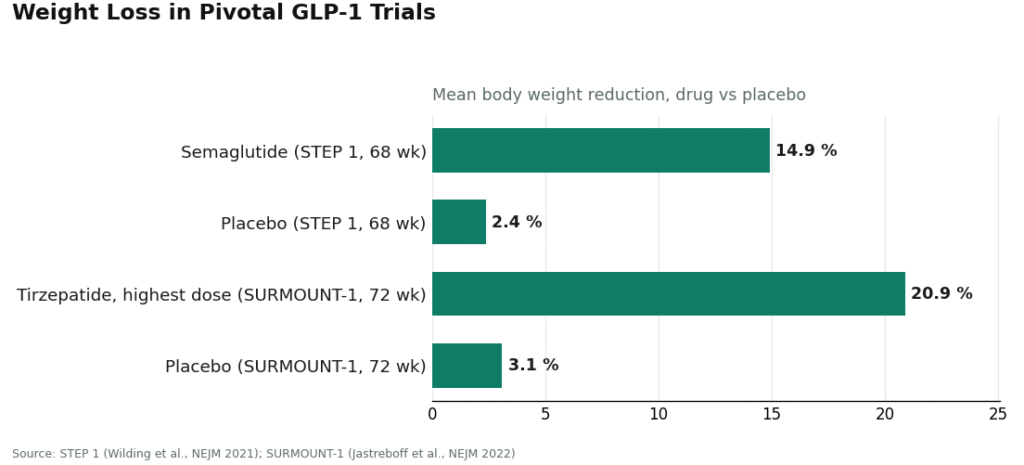
Tier one: full randomized trial data, FDA-approved finished products. In the STEP 1 trial (New England Journal of Medicine), once-weekly semaglutide produced a mean body-weight reduction of 14.9 percent over 68 weeks, against 2.4 percent for placebo (Wilding et al., NEJM 2021). That’s a 12.5-point spread. Tirzepatide did better in SURMOUNT-1: a 20.9 percent mean reduction at its highest dose over 72 weeks, versus 3.1 percent for placebo (Jastreboff et al., NEJM 2022), a spread of roughly 17.8 points.
Those numbers are real, but read the fine print on what they’re measuring: the FDA-approved, finished, tightly manufactured product. A compounded version of the same molecule is a different regulatory object. A “research use only” vial bought off a website is a third thing entirely, and nothing guarantees its contents match the label that produced those trial results.
Tier two: mostly preclinical. BPC-157 is the most-searched recovery peptide, and it does have a research base, it’s just almost entirely animal and mechanistic work. Published reviews describe promising effects in rodent models, with human clinical data still limited to a small number of early trials (Sikiric et al., Pharmaceuticals 2024; Front Pharmacol 2021). TB-500, GHK-Cu, and most longevity peptides sit in the same tier: interesting signal, thin human proof. That’s not a dismissal, it’s a data point. The rats look good. The human file is short.
So you have one tier with hard numbers behind approved products, and a second tier running almost entirely on preclinical promise. Any source that won’t tell you which peptide sits in which tier is a source I’d stop trusting.
Comparing the two doors, feature by feature
Here’s where I think the framing usually goes wrong: people assume the medical route is the expensive, slow option and the “research chemical” route is the savvy shortcut. Running the actual comparison side by side, that assumption doesn’t hold up.
| Question | Clinician + licensed pharmacy | “Research use only” vial |
|---|---|---|
| Does someone review your medical history first? | Yes | No |
| Is it compounded by a licensed pharmacy? | Yes | No |
| Does the FDA verify safety/effectiveness before it’s sold? | No, compounding isn’t FDA-verified either (FDA Q&A) | No |
| Is anyone legally accountable for what’s in the vial? | Yes | No |
That third row matters, because it kills the illusion that the medical door is “approved” and the other isn’t. Neither is FDA-approved in the strict sense when compounded. The real gap sits in rows one, two, and four: a clinician deciding if this fits your body, and a licensed pharmacy standing behind the product instead of an anonymous website.
FormBlends is one example of the structure done in the right order: clinician review first, prescription second, licensed 503A compounding pharmacy third. I’m citing it as an example of the door, not pitching you anything. There’s nothing here to add to a cart.
What the FDA did in March 2026, in one sentence
The gray market’s whole legal argument rested on a label: stamp it “research use only,” and it’s technically not a drug, technically not subject to drug rules. In a warning letter dated March 31, 2026, the FDA told the peptide seller Gram Peptides that its retatrutide and tirzepatide products were “unapproved new drugs under section 505(a),” writing that “despite statements on your product labeling marketing your products for ‘Research Use Only,’ and ‘not intended for human consumption, medical use, or veterinary use,’ evidence obtained from your website establishes that your products are intended to be drugs for human use” (FDA warning letter, Gram Peptides, 03/31/2026).
Worth flagging honestly: this is one enforcement action against one seller, an n of 1, not a sweep of the entire market. But it’s the FDA on the record saying the disclaimer is a legal fiction, not a shield. Extrapolate carefully, but don’t ignore what it tells you about how the agency reads these labels.
Layer on the physical risk. The FDA has warned that unapproved and counterfeit GLP-1 products circulating outside the regulated supply chain can carry the wrong dose or contain impurities, leaving buyers with no assurance of what they’re actually injecting (FDA, concerns with unapproved GLP-1 drugs). And on compounded drugs generally, the agency states plainly that a version that “is contaminated or contains too much active ingredient” “could cause serious injury or death” (FDA, understanding the risks of compounded drugs). A counterfeit vial looks identical to a legitimate one, right up until it doesn’t.
The honest ceiling on the medical door too
I don’t want to oversell the clinician route either, because the data doesn’t support that. Most of these peptides are not FDA-approved finished drugs. Many are available on the supervised route as compounded medications with a prescription, which is legal and regulated, but compounding is not approval. The FDA is direct about this: “FDA does not verify the safety, effectiveness or quality of compounded drugs before they are marketed” (FDA, compounding Q&A).
So what’s the actual value the medical door buys, if not an FDA stamp? A clinician judging whether this fits your medical profile, and a licensed pharmacy held to real quality standards instead of nobody. That’s not nothing, it’s the whole difference between a managed risk and an unmanaged one. But calling it risk-free would be its own kind of dishonesty.
My pick, stated plainly
Given the spread between the tier-one trial numbers and the largely preclinical data behind the recovery peptides, and given the flat legal reality the FDA laid out in March 2026, my read is simple. If you’re going to act on any of this, do it through the door with a named, accountable clinician and a licensed pharmacy on the other side. The molecule can be identical on both sides of that door. The number of people accountable for what happens to you is not: one versus zero.
The questions I get most
Is buying peptides labeled “research use only” for personal use actually legal? No. That label is a marketing workaround, not a legal shield. In its March 31, 2026 warning letter to Gram Peptides, the FDA rejected exactly that defense, stating the products were still “intended to be drugs for human use” despite the disclaimer, making them unapproved new drugs (FDA warning letter, 03/31/2026). The disclaimer protects the seller’s paperwork, not your body.
If it’s the same molecule on both sides, why does the source matter so much? Because the molecule is only one variable. The FDA has warned that products outside the regulated supply chain can carry the wrong dose or contain impurities you have no way to detect on your own (FDA, unapproved GLP-1 concerns). A licensed pharmacy answers to quality standards. An anonymous website answers to no one. Same molecule, very different risk math.
Does going through a clinician and pharmacy mean the product is FDA-approved? No, and treat any claim otherwise as a red flag. Most of these peptides are compounded, not approved, on the supervised route. Compounding is legal and regulated, but the FDA is explicit that it does not verify the safety, effectiveness, or quality of compounded drugs before they’re sold (FDA compounding Q&A). What you’re buying is clinical judgment plus pharmacy accountability, not an approval stamp.
Which peptides have the strongest human trial numbers? Semaglutide and tirzepatide, by a wide margin, because their branded finished products ran through full FDA trials. STEP 1 put semaglutide at 14.9 percent mean weight reduction versus 2.4 percent for placebo (Wilding et al., NEJM 2021); SURMOUNT-1 put tirzepatide at 20.9 percent versus 3.1 percent (Jastreboff et al., NEJM 2022). Recovery and longevity peptides like BPC-157, TB-500, and GHK-Cu sit much lower on the evidence ladder, mostly animal data with thin human trials (Sikiric et al., Pharmaceuticals 2024).
What’s the actual worst case with the chemical-door route? In the FDA’s own language: serious injury or death, from a compounded or counterfeit product that’s contaminated or overloaded with active ingredient (FDA, understanding the risks of compounded drugs). A counterfeit vial is visually indistinguishable from a real one until it isn’t, and by then it’s already in your body with no clinician and no licensed pharmacy anywhere near the decision.
What’s the single cleanest tell for whether a source is worth trusting? Whether it separates tier-one evidence from tier-two hype without blending them. A trustworthy source will tell you the GLP-1 peptides have real trial numbers in their approved forms while BPC-157 and its cousins are still mostly animal data. A source chasing your money flattens that gap so every vial sounds equally miraculous.
Where can I buy peptides legally in the United States?
Two legitimate paths exist: a licensed compounding pharmacy working from a valid prescription, or a research-chemical supplier selling compounds explicitly labeled “not for human use.” The first gives you pharmaceutical-grade sourcing, clinician oversight, and legal clarity. The second sits in a gray zone the FDA has signaled it intends to close. If you want something meant to actually go into your body, the prescription path is the only one that holds up.
Where do people actually buy peptides for muscle growth, and is it safe?
Most muscle-growth peptide buyers are shopping research-chemical sites, and the safety picture there is genuinely uncertain. Purity testing is inconsistent, dosing guidance is nonexistent, and there’s no medical backstop if something goes sideways. Some physicians do prescribe peptides like ipamorelin or CJC-1295 off-label for body composition, which at least puts a licensed provider in the chain. Slower, pricier, but the accountability is real.
Where to buy peptides for weight loss, and what should I watch out for?
Semaglutide and tirzepatide are FDA-approved prescription drugs, so a site selling them with no prescription required is a flag by itself. Retatrutide is still in trials with no approved source yet. Compounding pharmacies, including physician-supervised setups like FormBlends, can legally prepare certain peptides when a prescriber orders them, but that still means an actual clinical relationship, not a checkbox form.
What does Reddit actually get right and wrong about where to buy peptides?
Reddit surfaces real anecdotes about specific vendors, useful for gauging consistency and customer service. It’s weak on pharmacokinetics, long-term safety, and legal exposure, exactly the areas where anecdote can’t substitute for data. Self-reported lab tests posted by users add some signal but are unverified. Treat it as one data point, not a sourcing authority.
References
- FDA, “Compounding and the FDA: Questions and Answers.”; the FDA does not verify their safety, effectiveness or quality before marketing.
- FDA, “Understanding the Risks of Compounded Drugs.” A compounded drug that is contaminated or contains too much active ingredient could cause serious injury or death.
- FDA, “FDA’s Concerns with Unapproved GLP-1 Drugs Used for Weight Loss.” Unapproved and counterfeit GLP-1 products outside the regulated supply chain carry dosing and contamination risk.
- FDA warning letter, Gram Peptides (March 31, 2026). Retatrutide and tirzepatide named as unapproved new drugs; “Research Use Only” and “not intended for human consumption” framing rejected as a defense.
- Wilding JPH, et al. “Once-Weekly Semaglutide in Adults with Overweight or Obesity.” N Engl J Med. 2021. STEP 1: 14.9% mean weight reduction versus 2.4% placebo at week 68. PMID 33567185.
- Jastreboff AM, et al. “Tirzepatide Once Weekly for the Treatment of Obesity.” N Engl J Med. 2022. SURMOUNT-1: 20.9% mean weight reduction at 15 mg versus 3.1% placebo at week 72. PMID 35658024.
- Sikiric P, et al. Review of BPC-157, activity drawn largely from preclinical and mechanistic studies. Pharmaceuticals (Basel). 2024. PMID 38675421.
- “Stable Gastric Pentadecapeptide BPC 157 and Wound Healing.” Front Pharmacol. 2021. Supporting evidence predominantly from animal models. PMC8275860.